

Introduction
The Fastest T20 century is one of the most thrilling facts in current cricket. A T20 century calls for excellent timing, energy, shot choice, strolling between the wickets, and the ability to assault nearly every sort of bowling.
For many years, Chris Gayle’s well-known 30-ball century for Royal Challengers Bangalore inside the IPL became seemed because the benchmark for the quickest century in senior T20 cricket. However, Estonia’s Sahil Chauhan changed the record book in June 2024 while he reached his century in most effective 27 balls towards Cyprus. The International Cricket Council and Guinness World Records recognized Chauhan’s innings as the Fastest men’s T20I century.
Table of Contents
The report becomes extra interesting because there are exceptional categories of T20 cricket. A T20 International isn’t always the same as an IPL match or some other home T20 competition. Therefore, it is critical to understand precisely which record is being mentioned.
What Is the Fastest T20 Century?
As of October 2026, Sahil Chauhan of Estonia holds the men’s T20I report for the fastest century, attaining 100 runs from handiest 27 balls against Cyprus on 17 June 2024.
His amazing innings in the end was completed at 144 not out from 41 balls, inclusive. His century broke Jan Nicol Loftie-Eaton’s preceding 33-ball T20I record by six deliveries.
Chauhan’s 27-ball hundred additionally exceeded Chris Gayle’s famous 30-ball century for Royal Challengers Bangalore against Pune Warriors India in the 2013 IPL while thinking about senior men’s T20 cricket universally.
Fastest T20 Century at a Glance
| Record | Player | Balls to Century | Team | Opposition | Year |
|---|---|---|---|---|---|
| Fastest men’s T20I century | Sahil Chauhan | 27 | Estonia | Cyprus | 2024 |
| 2nd-fastest T20I century | Muhammad Fahad | 29 | Turkey | Bulgaria | 2025 |
| Fastest Indian T20I century | Abhishek Sharma | 30 | India | Afghanistan | 2026 |
| Fastest full-member T20I century | Abhishek Sharma | 30 | India | Afghanistan | 2026 |
| Previous T20I record | Jan Nicol Loftie-Eaton | 33 | Namibia | Nepal | 2024 |
| Previous full-member record | Finn Allen | 33 | New Zealand | South Africa | 2026 |
| Famous IPL/T20 record before Chauhan | Chris Gayle | 30 | RCB | Pune Warriors India | 2013 |
The key point is that 27 balls is currently the men’s T20I benchmark, while Chris Gayle’s 30-ball innings stays one of the most famous T20 centuries in cricket records.
Sahil Chauhan – Fastest T20I Century in History
Sahil Chauhan produced one of the greatest batting performances in T20 cricket whilst Estonia performed Cyprus in Episkopi on 17 June 2024.
Estonia were chasing a target of 192. Chauhan got to the crease along with his team in hassle at 9 for two after 1.2 overs. Instead of slowing the innings down, he attacked the bowling right away.
He reached his century in just 27 balls and in the end remained unbeaten on 144 from 41 balls.
His innings covered:
- 27 balls to reach 100
- 144* from 41 balls
- 18 sixes
- Strike charge of 351.21
- 18 sixes, then a men’s T20I record for an individual innings
The ICC mentioned that Chauhan’s century broke the preceding document by means of six balls and that his 18 sixes additionally established a new men’s T20I document on the time.
His performance demonstrated how quickly a T20 innings can alternate. Estonia went from early strain to a hit chase because Chauhan combined boundary hitting with an incredible scoring pace.
Chris Gayle’s Famous 30-Ball Century
Before Sahil Chauhan’s 27-ball hundred, Chris Gayle became the name most intently related to the fastest century in T20 cricket.
Gayle scored his century in just 30 balls, even as gambling for Royal Challengers Bangalore against Pune Warriors India in the 2013 IPL.
The innings have become mythical. Gayle ultimately scored 175 not out, which was also the very best individual score in guys’ T20 cricket for decades.
The crucial difference is that Gayle’s innings became an IPL franchise highlight, now not a T20 International.
Therefore:
Chris Gayle = 30-ball IPL century
Sahil Chauhan = 27-ball T20I century
This difference topics when writing about the “fastest T20 century” because T20 consists of many domestic and franchise competitions, at the same time as T20I mainly means global cricket between recognized national teams.
Abhishek Sharma’s 30-Ball T20I Century
Indian cricket also entered the quickest-century discussion in a prime way in September 2026.
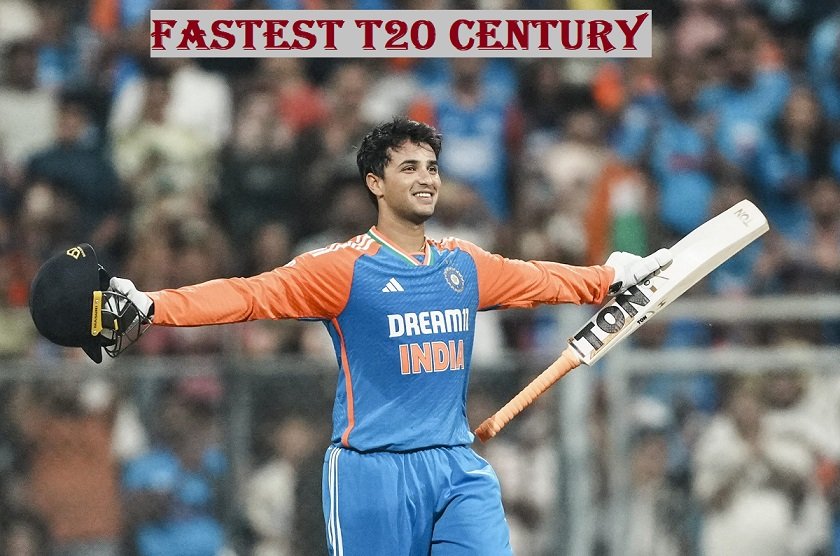
India opener Abhishek Sharma scored a T20I century in only 30 balls against Afghanistan in New Delhi on 17 September 2026.
He completed it with 108 runs from 34 balls, along with 9 fours and 11 sixes. The BCCI showed that his century became the quickest by an Indian batter in men’s T20Is, surpassing Rohit Sharma’s preceding Indian record of 35 balls.
Abhishek’s innings become specially vast because it become not only an Indian report. It is also the fastest century in a T20I among full-member nations on record.
According to the BCCI, his 30-ball century was the third-fastest in men’s T20Is, behind Sahil Chauhan’s 27-ball effort and Muhammad Fahad’s 29-ball century.
Fastest T20I Centuries – Top Players
The following table provides a useful snapshot of the leading men’s T20I centuries by way of balls required to reach 100.
| Rank | Player | Team | Balls | Opposition | Year |
|---|---|---|---|---|---|
| 1 | Sahil Chauhan | Estonia | 27 | Cyprus | 2024 |
| 2 | Muhammad Fahad | Turkey | 29 | Bulgaria | 2025 |
| 3 | Abhishek Sharma | India | 30 | Afghanistan | 2026 |
| 4= | Jan Nicol Loftie-Eaton | Namibia | 33 | Nepal | 2024 |
| 4= | Sikandar Raza | Zimbabwe | 33 | Gambia | 2024 |
| 4= | Finn Allen | New Zealand | 33 | South Africa | 2026 |
| 7 | Kushal Malla | Nepal | 34 | Mongolia | 2023 |
| 8= | David Miller | South Africa | 35 | Bangladesh | 2017 |
| 8= | Rohit Sharma | India | 35 | Sri Lanka | 2017 |
| 8= | Sudesh Wickramasekara | Czech Republic | 35 | Turkey | 2019 |
These ratings refer to men’s T20 International cricket. The BCCI confirms Abhishek’s 30-ball century as the third-fastest, even as ICC information verifies Chauhan’s 27-ball mark.
Jan Nicol Loftie-Eaton’s 33-Ball Century
Before Chauhan broke the record, Namibia’s Jan Nicol Loftie-Eaton created records against Nepal in February 2024.
He reached his T20I century in 33 balls, placing a brand new record on the books.
His document lasted much less than four months because Chauhan produced his brilliant 27-ball 100 in June 2024.
Loftie-Eaton’s performance remains an important part of the latest history of T20 cricket as it confirmed how quickly the T20I century document began to fall.
Muhammad Fahad’s 29-Ball Century
Turkey’s Muhammad Fahad also produced a fantastic T20I overall performance in 2025.
He reached his century in 29 balls against Bulgaria, becoming the second participant to reach a T20I 100 in fewer than 30 balls.
That innings placed him directly behind Sahil Chauhan in the all-time T20I record list. Current record listings place Fahad’s 29-ball century among Chauhan’s 27-ball record and Abhishek Sharma’s 30-ball effort.
Rohit Sharma’s 35-Ball Century
Indian captain and batting movie star Rohit Sharma formerly held the Indian T20I record.
On 22 December 2017, Rohit scored a century from 35 balls against Sri Lanka in Indore.
His innings ended at 118 runs from 43 balls. At the time, his 35-ball century equalled David Miller’s then T20I record.
mentioned that Rohit became the joint-fastest T20I centurion while he matched Miller’s 35-ball attempt.
Rohit’s record remained India’s T20I benchmark for numerous years before Abhishek Sharma in the end handed it with his 30-ball century in 2026.
David Miller’s 35-Ball Century
South Africa’s David Miller was the primary player to score a T20I century in 35 balls.
Miller achieved the feat in opposition to Bangladesh in Potchefstroom on 29 October 2017.
He finished unbeaten on 101 from 36 balls. His innings contained 12 fours and 5 sixes.
Miller’s performance broke the previous T20I record and installed a new benchmark that Rohit Sharma equalled only some months later.
Fastest T20 Century vs Fastest T20I Century
These two phrases ought to no longer be treated as exactly identical.
Fastest T20I Century
A T20I century should be scored in an authentic Twenty20 International.
The present-day men’s document is:
Sahil Chauhan – 27 balls – Estonia vs Cyprus, 2024.
Fastest T20 Century
This broader term can include domestic and franchise T20 cricket as well as internationals.
Sahil Chauhan’s 27-ball T20I century is consequently also the benchmark for senior men’s T20 cricket according to Guinness World Records, which states that it exceeded Gayle’s previous 30-ball mark.
Fastest T20 World Cup Century
The T20 World Cup is every other year.
The quickest men’s T20 World Cup century is Finn Allen’s 33-ball century for New Zealand against South Africa in the 2026 tournament. Wisden mentioned that Allen’s 33-ball hundred became the fastest in a men’s T20 World Cup and also the quickest century in a match between two full member nations at that point.
This isn’t like the general T20I document because T20 World Cup matches represent one specific worldwide opposition.
Why Is a Fast T20 Century So Difficult?
Scoring 100 runs in fewer than 35 balls requires an extremely good combination of competencies.
A batter wishes:
- Exceptional power – Many runs have to come from boundaries.
- Perfect timing – Clean hitting reduces the need to take pointless risks.
- Strong shot choice – The batter must become aware of scoring opportunities quickly.
- Confidence – A batter can not have enough money to turn out to be protective after scoring quickly.
- Fitness – Running between the wickets remains critical even throughout a boundary-heavy innings.
- Adaptability – T20 bowlers use yorkers, slower balls, bouncers and extensive deliveries to forestall competitive batters.
- Favorable situations – Pitch, ground dimensions and climate can have an effect on scoring.
- Partnership support – A sturdy associate can maintain the strike moving and reduce strain.
How Many Boundaries Are Needed for a Fast Century?
A hundred-run innings in 30 balls calls for an extremely good scoring fee.
For instance, if a batter scored 60 runs from obstacles and accumulated another 40 runs through singles, doubles and triples, the innings might nevertheless require extremely competitive strolling and shot-making.
The quickest centuries often incorporate a completely excessive percentage of boundary runs. Abhishek Sharma’s 30-ball century in opposition to Afghanistan is a superb example: the BCCI mentioned that he scored 96 of his one hundred runs via obstacles while he reached the milestone.
Fastest T20 Century Records – Important Facts
| Category | Record | Player |
|---|---|---|
| Fastest men’s T20I century | 27 balls | Sahil Chauhan |
| Fastest century against a Test/full-member nation in T20I | 30 balls | Abhishek Sharma |
| Fastest Indian T20I century | 30 balls | Abhishek Sharma |
| Famous 30-ball IPL century | 30 balls | Chris Gayle |
| Fastest T20 World Cup century | 33 balls | Finn Allen |
| Previous Indian T20I record | 35 balls | Rohit Sharma |
| Previous T20I record | 35 balls | David Miller |
| Previous T20I record before Chauhan | 33 balls | Jan Nicol Loftie-Eaton |
What Makes the Fastest T20 Century Special?
A T20 century is already tough because teams have at most a hundred and twenty felony deliveries in an entire innings.
A batter scoring 100 runs in 30 balls is working at a scoring rate of more than three hundred runs consistent with a hundred balls.
A 27-ball century calls for a fair extra exquisite scoring charge.
Sahil Chauhan’s 27-ball century became therefore not genuinely a quick hundred. It became a performance that modified the file book for men’s global T20 cricket.
The rise of gamers including Chauhan, Fahad, Abhishek Sharma and Finn Allen additionally shows how hastily T20 batting is evolving.
Conclusion
The Fastest T20 century is considered one of cricket’s most spectacular batting performances. As of October 2026, Sahil Chauhan holds the men’s T20I record after attaining his century in only 27 balls for Estonia in opposition to Cyprus in 2024. The ICC and Guinness World Records recognize this splendid success.
India’s Abhishek Sharma has also become a first-rate part of the record dialogue after scoring a 30-ball T20I century towards Afghanistan in September 2026. His success broke Rohit Sharma’s Indian report and have become the fastest T20I century through an Indian batter.
Meanwhile, Chris Gayle’s 30-ball IPL century remains one of the most iconic T20 innings ever played, even as Finn Allen’s 33-ball century holds the distinction of being the fastest men’s T20 World Cup hundred.